


Drive Confidently This Winter: Goodyear’s 2025/26 Guide to Winter Tire Regulations
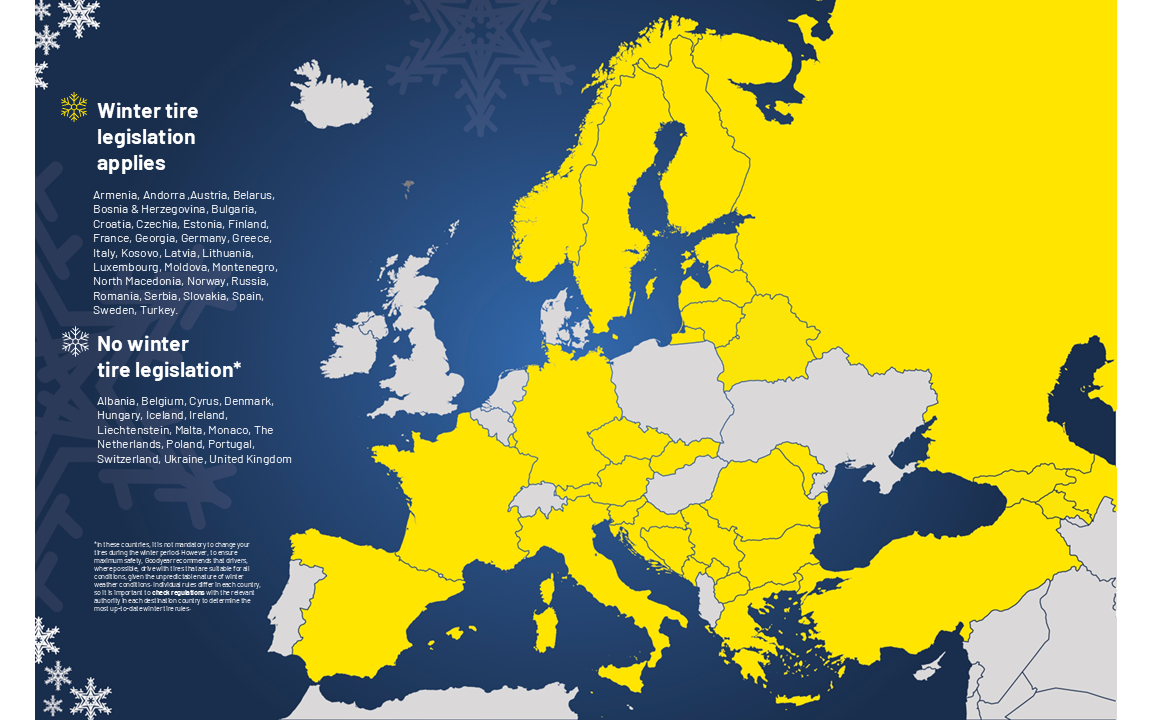
Goodyear provides updates on key legislation in European countries, tire safety advice and top tips for preparing your car for winter
Planning a journey through Europe in winter involves preparing for rapidly changing weather and a patchwork of national tire rules. As temperatures drop and roads become more challenging, Goodyear is here to help drivers navigate complex and evolving winter tire regulations with an updated 2025 guide.
Winter tires play a crucial role in cold weather driving, providing reliable grip and shorter braking distances when temperatures fall below 7°C. They are engineered with special rubber compounds and tread patterns to channel away water, reduce aquaplaning and maintain traction on snow and ice.
Your Guide to Winter Tires in Europe
With new legislation updates for 2025, it’s essential to know the rules of your destination. Here’s what you need to know about winter tires across Europe this winter1:
France
From 1 November to 31 March, winter tire rules are in place across mountainous regions, subject to decisions by local authorities. This area covers 34 French départements and mountain ranges such as the Alps, the Massif Central and the Pyrenees.
Winter and all-season tires with 3PMSF marking meet the legal requirement, with one exception for trailer tires on commercial vehicles. Studded tires are allowed on passenger vehicles only, whilst chains or snow socks can be used if mounted on the drive axle.
Germany
There is no fixed calendar period for winter tire use in Germany and so drivers are only legally mandated to fit winter tires if the weather conditions require it.
Vehicles must be equipped with 3PMSF-marked tires, and studded tires are not permitted for either passenger or commercial vehicles.
Italy
Winter tire requirements in Italy are based on road signs, with obligations enforced from 15 November to 15 April and in wintry conditions2. Tires with M+S marking and at least 1.6mm tread are permitted.
Chains must be available in the vehicle if snow tires are not mounted when driving on roads with signs. Passenger vehicles are permitted to use studded tires, which can improve grip on icy or snowy roads. There is also a one month period either side of November and April for mounting and dismounting winter tires.
Spain
Winter tires or snow chains are mandatory where indicated by road signs. Studded tires are allowed on passenger and commercial vehicles during the winter period which is from the last Saturday before November (25 October 2025) to the last Sunday in March (29 March 2026). 3PMSF-marked tires are also permitted for both vehicle types.
Additionally, buses must display a sign showing they are equipped with winter tires.
Sweden
With new legislation effective from 1 November 2025, Sweden will extend the period during which winter tires are mandatory on heavy duty vehicles from 10 November to 10 April, regardless of road conditions.
For passenger vehicles, from 1 December to 31 March winter tires must be fitted. Approved tire options include 3PMSF or studded tires with a minimum tread depth of 3mm. For vehicles with studded tires, trailers must also be similarly equipped. M+S tires are allowed on trailers for passenger and commercial vehicles in a transitional period until 2028.
Elsewhere in Europe
Countries who mandate the use of winter tires during set time periods include Andorra, Armenia, Belarus, Bosnia & Herzegovina, Bulgaria, Croatia, Estonia, Georgia, Kazakhstan, Kyrgyzstan, Kosovo, Latvia, Lithuania, North Macedonia, Montenegro, Russia, Slovenia and Turkey.
Countries who mandate the use of winter tires only in wintry conditions or those weather conditions in a set time period include Austria, Czech Republic, Finland, Greece, Luxembourg, Moldova, Norway, Romania, Serbia and Slovakia.
There is no legal requirement to fit winter tires in Albania, Belgium, Cyprus, Hungary, Iceland, Ireland, Liechtenstein, Malta, Monaco, the Netherlands, Poland, Portugal, Switzerland, Ukraine and the United Kingdom.
Decoding Winter Tire Symbols
Winter tires are usually marked with the M+S symbol and/or the ‘Alpine’ symbol (3-Peak Mountain Snow Flake, or 3PMSF). A tire with M+S marking features tread design, rubber compound and construction tailored to provide better performance in mud and snow compared to standard tires.
Tires with the 3PMSF symbol have passed a dedicated snow grip test and meet official UN standards (Regulation No. 117)3. Many European countries now require 3PMSF-approved tires for winter driving, reflecting their proven safety benefits.
Goodyear’s winter and all-season tire ranges carry the 3PMSF mark, ensuring drivers have access to products that meet the highest standards for performance and safety in wintry conditions.
Don’t Leave Safety to Chance: Prepare Your Tires This Winter
Goodyear urges all drivers travelling in Europe this winter to review local regulations before departure and to prepare your vehicle for the season. Even in countries without mandatory winter tire laws, fitting appropriate tires is the best way to maximize safety given unpredictable winter weather.
For the latest updates and to ensure compliance, always consult official sources or local authorities prior to travel.
1Status as of publication date of this news
2 https://www.autostrade.it/en/la-nostra-rete/operazioni-invernali
3 EU Truck Tyre Label | Goodyear
About The Goodyear Tire & Rubber Company
Goodyear is one of the world's largest tire companies. It employs about 68,000 people and manufactures its products in 51 facilities in 19 countries around the world. Its two Innovation Centers in Akron, Ohio, and Colmar-Berg, Luxembourg, strive to develop state-of-the-art products and services that set the technology and performance standard for the industry. For more information about Goodyear and its products, go to www.goodyear.com/corporate.