


Goodyear’s guide to driving in summer in Europe
Whether you are a local or a tourist taking on a scenic summer driving holiday, it can be challenging to navigate the different road regulations across Europe. Although the summer season generally brings more favourable driving conditions, driving in unfamiliar environments still requires preparation.
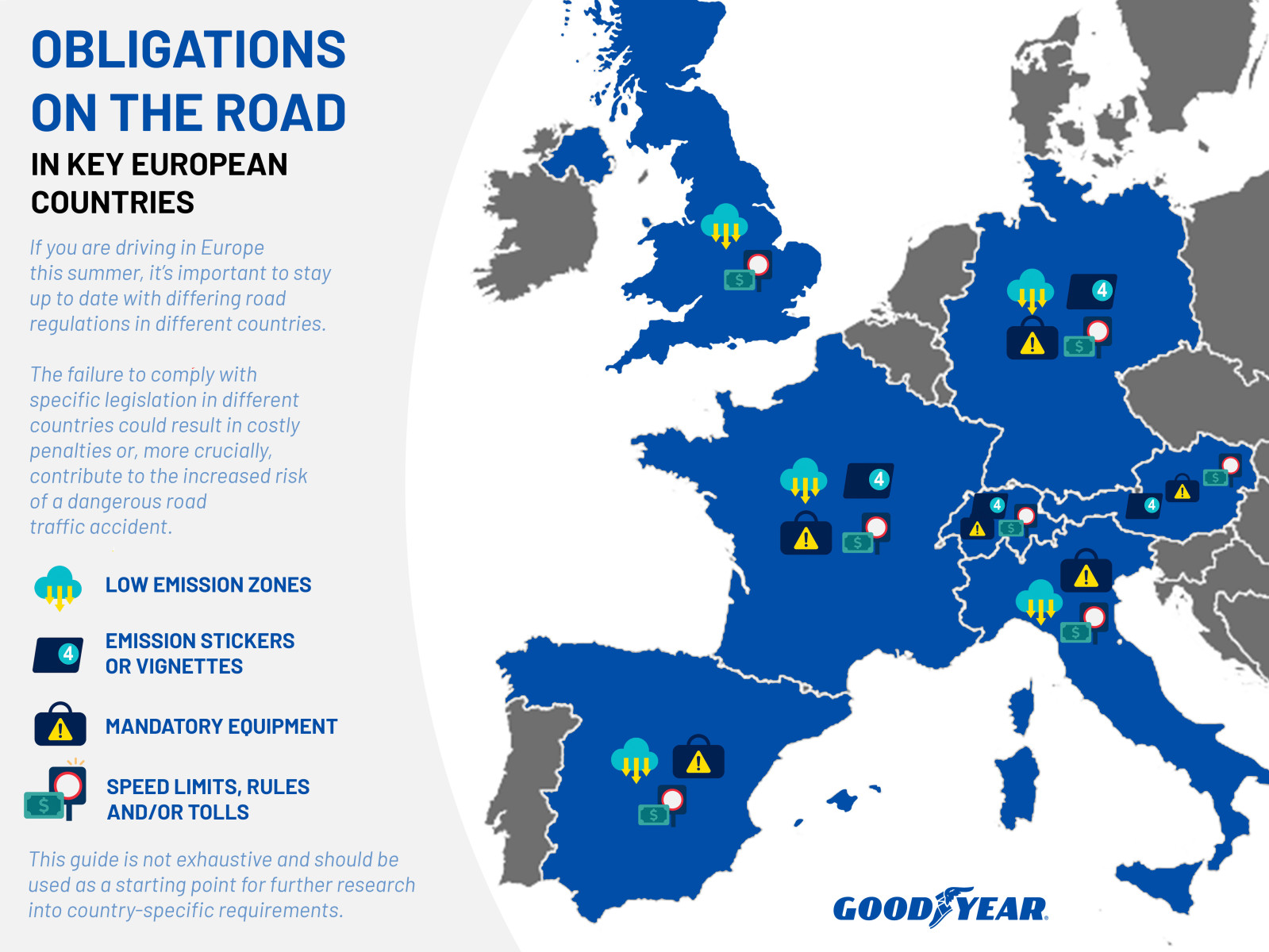
If you are driving in Europe this summer, it’s important to stay up to date with differing road regulations in different countries. The failure to comply with specific legislation in different countries could result in costly penalties or, more crucially, contribute to the increased risk of a dangerous road traffic accident.
Goodyear has created a useful guide to help drivers stay compliant with national road laws throughout the continent so you can amplify your driving pleasure and feel at one with the road this summer. Please note that this guide is not exhaustive and should be used as a starting point for further research into country-specific requirements.
Why summer tires matter
Before considering country-specific regulations, it is important to make sure you have the right tires fitted for safe, comfortable, and efficient summer driving. Summer tires boast high tread elasticity and stiff compounds to perform best in warm weather in both wet and dry conditions. That means you will get precise handling, excellent grip, and short braking distances - even if it rains.
All Goodyear premium summer tires are tailored to meet the specific requirements of electric vehicles. In fact, all Goodyear tires are designed to be suitable for both electric vehicles (EVs) and traditional internal combustion engine (ICE) vehicles.
Crucial elements of the relevant regulations across Europe, as they stand today, appear below.1 It is important to note that it is always the driver’s responsibility to check the most up-to-date legislation before a trip to each region or country.
Drivers should also remember to conduct other safety checks before a journey. These include checking your car over before you set off and inspecting tires for tread depth and incorrect pressures.
Key legislation across Europe
France: With France’s diverse landscapes, stunning countryside, historic towns and vibrant cities, it is one of the ideal European destinations for a summer driving holiday.
If you are driving a vehicle into France - and most of the other European destinations in this guide - it is mandatory that you carry with you a reflective jacket, a warning triangle, and headlamp beam deflectors (if driving a right-hand drive car).
French regulations also stipulate that a Crit'Air sticker is displayed on your car when travelling to certain cities with Low Emission Zones (Zones à Faibles Émissions or ZFEs). Failure to display the correct Crit'Air sticker could result in an on-the-spot fine of €135.
In France, the speed limit in normal traffic conditions is 130 km/h on motorways, 110 km/h on dual carriageways, 80 km/h on other roads and 50 km/h in built up areas. If you drive a caravan or have a trailer, these may vary. Speed limits are lowered in rain and other adverse weather conditions in France.
Like in most countries, it’s illegal to use a mobile phone while driving in France, however hands-free units are allowed. It's also illegal to use headphones, including bluetooth devices, whilst on the road. Disobeying these laws could lead to a fine of €135.
Before 2020, drivers in France were required to carry a breathalyser kit with at least two disposable testing units. This is no longer a legal requirement, however it's still recommended to carry one, especially if you plan on drinking a small amount of alcohol on your trip.
Germany: Many sections of the Autobahn are famously unrestricted. But, like other European countries, Germany has a unique set of rules for drivers.
For example, if you have a navigation system that shows the location of fixed speed cameras, you must deactivate this function on the system as it is illegal to carry or use any radar detection equipment when driving through Germany.
Many sections of the Autobahn have no speed limit, which is indicated by a circular white road sign with five diagonal black lines. You can drive as fast as you feel safe in these areas, but be aware that cars can appear behind you suddenly, so take extra care when overtaking.
On the Autobahn, it's crucial to follow specific etiquette and rules for safe driving. For example you must keep right unless overtaking, overtake on the left, and use your indicator signals when changing lanes. You must also always maintain a safe following distance and avoid tailgating cars in front of you.
Germany also enforces environmental zones (Umweltzonen) in many cities. It’s a legal requirement for cars to feature emissions stickers - known as Umweltplakette - when entering some of the major cities in Germany. Unnecessary car engine idling is also prohibited under environmental and noise laws.
Italy: Exploring Italy by car offers a unique “La Dolce Vita” experience, allowing you to see diverse landscapes and charming towns at your own pace. In Italy, summer months bring increased enforcement of speed limits and congestion charges in major cities such as Milan and Rome.
The Italian low-emission ZTL (Zona a Traffico Limitato) zones are strictly monitored with cameras, and unallowed entry to these zones can lead to hefty fines. Drivers should also be aware that some Italian mountain passes may have local restrictions in place during peak summer periods due to high volumes of traffic.
In Italy, overtaking is prohibited in specific situations, including on and approaching level crossings and when visibility is limited. If you plan to tow in Italy, campervans and cars with caravans are not allowed to exceed 12 metres in length, 4 metres in height and 2.55 metres in width.
You should also be aware of differing speed limits in Italy, depending on the type of road you are driving on. Speeding fines in Italy range depending on the speed at which the driver is caught, and the road on which you are driving.
Like many other European countries, Italy has motorways with tolls. You can pay for them with cash or a credit card at toll booths.
Spain: Spain is a great destination for a summer driving holiday. It has a well-connected road network and the ability for drivers to choose between scenic coastal drives along the Mediterranean and exploring the Pyrenees mountains or the Basque Country.
Major cities such as Barcelona operate low emission zones. In Barcelona, an area covering 95 square kilometres is a low emission zone. Restrictions apply depending on when your vehicle was registered and what type of fuel system it operates.
In rural areas, it's crucial to also be aware of speed limits, especially during the summer months when enforcement may be stricter. Goodyear recommends you research Spanish speed limits before leaving for your holiday.
United Kingdom: For drivers arriving into the United Kingdom, it can be one of the most difficult countries to adapt to in Europe. This is because unlike in most European countries, traffic in the UK drives on the left. This also means you give way to traffic approaching on your right at roundabouts.
Speed limits in the UK are in mph, not km/h, which can be confusing for new drivers or those unfamiliar with the British system. Limits change depending on the type of vehicle you are driving and the roads on which you are driving. The UK enforces speed limits strictly, and a large number of speed cameras are used to monitor and enforce these limits on various road types.
There are some toll roads in the UK. The busiest are the Dartford River Crossing on the M25 and the M6 Toll Midlands Expressway. In London and some other major UK cities, there are LEZ (Low Emission Zones) or CAZ (Clean Air Zones) that charge a fee for older, more polluting vehicles to enter that do not meet emissions standards. Always check the regulations in the city you will be driving in before you enter.
Austria and Switzerland: Austria and Switzerland have some of the most beautiful roads in Europe, making them ideal road trip destinations. But if you’re planning a trip, you must make sure you’re prepared.
Both countries require motorway vignettes (toll stickers) for use on major roads. In summer, tunnels and alpine passes can become congested or subject to temporary restrictions due to the influx of tourists. Switzerland also enforces noise restrictions in certain areas, especially for motorcycles, particularly during the warmer months.
Speed limits in both countries differ depending on the type of road you are travelling on. Goodyear recommends that you research this topic before you leave for your holiday.
In Switzerland, unusually it is illegal to wash your car by hand on Sundays. While it is unlikely you will be doing this whilst on holiday, it is an important rule to be aware of. This is due to Sunday being a day of rest, as well as a concern for the potential environmental impact from chemicals entering the drainage systems.
Other must-know driving rules across Europe:
- Portugal: It is illegal to tow a vehicle with a rope or chain; only a rigid tow bar is permitted.
- Netherlands: Speed limits in the Netherlands were reduced in 2020 to 100 km/h on many motorways during daytime hours to help tackle air pollution.
- Norway: You must use dipped headlights at all times, even during long daylight summer hours.
- Finland: If you hit a large animal on the road, such as an elk or reindeer, you must report it to the police immediately.
- Czech Republic: The legal alcohol limit for all drivers is 0.0%. You must also keep your daytime running lights on at all times.
- Slovenia: Headlights must be used at all times. A motorway vignette is also required for use on motorways and expressways.
- Hungary: Hungary has a zero-tolerance policy for all drivers. This means the legal alcohol limit for all drivers is 0.0%.
- Poland: All vehicles must carry a fire extinguisher, in addition to the standard hazard triangle and jacket. Dipped headlights must be on at all times, regardless of weather or time of day.
- Iceland: It is illegal to drive off-road, even if the terrain appears open and accessible.
No matter where you travel in Europe, it is important to always check the latest national and regional road regulations before your journey. Traffic laws can change and may vary depending on the local authority in the region you are travelling. Goodyear recommends that you use summer tires for optimal safety and performance and reminds all drivers to carry essential safety equipment, observe speed limits, and remain alert to variable road signage and local conditions.
If your destination country is not listed here, make sure to research the relevant driving laws or consult local legislation before you travel. Take your driving experience to new heights, with Goodyear. You won't look back.
[1] Status as of publication date of this news. This guide is not exhaustive and should be used as a starting point for further research into country-specific requirements.
About The Goodyear Tire & Rubber Company
Goodyear is one of the world's largest tire companies. It employs about 68,000 people and manufactures its products in 53 facilities in 20 countries around the world. Its two Innovation Centers in Akron, Ohio, and Colmar-Berg, Luxembourg, strive to develop state-of-the-art products and services that set the technology and performance standard for the industry. For more information about Goodyear and its products, go to www.goodyear.com/corporate.